Bookmark and Share

A Street Trader Calls

Thoughts on an Entrepreneur – Lilongwe, Malawi 12 January 1996
On returning from our visit to the SOS Children’s Village in Lilongwe we were intrigued by a trader with a bicycle who came into the garden, and what his future prospects might be. Not good, it seems.
We walked to Penny and John’s office, which entails crossing the garden, and there in the garden was a street trader with a bicycle and a cloth containing small piles of aubergines, tomatoes, mangoes, etc each selling for a fixed price per pile, or at least a set price per pile, possibly not that fixed.
Penny and John say he is doing well and if this good fortune continues he will eventually be beaten up by his neighbours or at the very least have his bicycle demolished. P&J take this as further evidence of how dumb Malawians are; they are unaware of the peer-to-peer pressure of the peasant. The peasant’s desire, passionate mission, is to stay a peasant and he will hit out at anyone who challenges that. This is by no means solely a Malawian trait. [Next political . . .]

The Vice-President’s Wife Deigns to Call

At the SOS Children’s Village, Lilongwe, 13 January 1996
Our third day in Malawi, on the second we had visited the SOS Children’s Village, and today we do so again, we meet the vice-president’s wife; and Barbie and Ken who might take over the running of the village; and we learn a couple of words of chichewa.
Today Hilary is running a training course at the village and we had planned to visit Lilongwe market this afternoon, this plan gets thwarted when the wife of the first vice-president of Malawi decides to postpone her planned 9am visit until the afternoon.
We all assemble to see the performance that the children have planned in honour of the visit of the wife of the first vice-president. She arrives over an hour late, which we are told is the norm in Malawi, though it’s probably actually the norm worldwide for rather mediocre people who want to show they are important, thus unwittingly demonstrating precisely the opposite.
We watch a performance of plays and songs about ‘EDSI’ (AIDS) and ‘Johnson’, which is a Malawi-accented English rendition of ‘Don’t Smoke’.
Then Mrs vice-president gives the children some cakes and they are told they can watch a video (Malawi has no television).
We go for tea with a couple of Afrikaners called Marti and Gerald, or Marti and Jirrald, or, according to Penny from her girls’ school slang perspective: Barbie and Ken; Barbie with make-up extending to the inside of her earholes. Barbie and Ken want to take over the running of the village when Penny and John leave in April, but everyone except John is suspicious of their motives; they are running away from the new South Africa and seem to like above all the idea of a big house with houseboys. John seems unconcerned about this.
Barbie and Ken ooh and aah over the little black children in much too sentimental a way, we cannot decide whether it is insincerity or they would do the same with baby monkeys. We are tense with Barbie and Ken.
So why is John, of all people, so sanguine about this. John who treats everyone with respect and bland equality and who will see through a charlatan without even needing to put his glasses on? We come to learn why, about which more later.
Having bid goodbye to Barbie and Ken we go back to Penny and John’s house for another jolly dinner, and more info about Malawians, AIDS, and aid, both of which seem to be Malawi’s greatest problems. [Next political . . .]
Before dinner, John throws some sticks into the garden for the dogs to retrieve. One of his three dogs is a pit-bull terrier, named Einstein, and John gives a demonstration of how, once Einstein has got hold of a stick in his teeth, he will not let go even though John takes hold of the other end of the stick and swings it round and round his head, Einstein still gripping the other end and being swung round and round in high circles. Einstein loves this game, it is his party-piece. The only way to get Einstein told let go of the stick is for John to tell him to drop it. Doggies love to obey their master. Creepy.
By listening to Mrs vice-president and the children, we have learned to say yes and no in Chichewa. Yes is eh, and no is uh uh. (I've since looked this up. http://wikitravel.org/en/Nyanja_phrasebook says that yes is ee, and no iyaya, so we weren’t too far off.
Chichewa seems to have no distinction between L and R sounds, so when speaking English Malawians use these interchangeably. Someone tells us that he burned his arm when he sripped and put his hand into the file.
The story continues with A Day at the Seaside, Malawian Style.

A Day at the Seaside, Malawian-Style

Well, not exactly Malawian-style, more European-style in Malawi – Salima, Malawi 14 January 1996
Our fourth day in Malawi, following-on from attending a performance by children from the SOS Children’s Village for the vice-president’s wife. We drive along the Malawian motorway to the seaside and ponder on grain, buses and employment.
Today, we go to the seaside, ie lakeside. We all bundled into the old Toyota, stopped at the garage for diesel and bananas, then drove off along the new, British-built road to Salima on Lake Malawi.
This road is a Malawian motorway. It is like a British single-carriageway A-road, with white lines down the middle. Malawian drivers take no notice at all of these, they drive their vehicles at full speed, which could be anything from five to ninety-five miles per hour. The other significant difference from a British motorway is that there is a continuous stream of people walking along the hard shoulder, which is as often as not a soft shoulder. Dead dogs appear in the road every few miles, some surrounded by rocks, where the dog had been knocked down by a car but not killed, so the children finish it off by with a game of throwing stones at in from the roadway edge.
The road passes by fields of maize, rice and cassava, though mostly maize, and through villages of clustered mud huts with thatched roofs.
Malawians live on maize, mostly on maize flour made into a porridge, called nsima. Their diet is said to be getting worse, as high-yielding maize is grown to replace the less profitable groundnuts and cassava. Also, when crops fail or are exhausted, then instead of people eating wild mangoes while they starve as of yore, they are provided by the west with: yet more maize.
Driving towards Salima we pass a large grain store, Malawi’s pride and joy to the extent that a drawing of it appears on every banknote. There is no grain in it. Malawi is a subsistence economy that produces no surplus grain. The store was donated by the EU. [Next political . . .]
We stop at the stalls selling woodcarvings to the tourists. The carvings tend to be done to a formula, though are all hand carved and polished with shoe polish. In Europe the amount of manual effort would make them a luxury item, even if they are done to a formula.
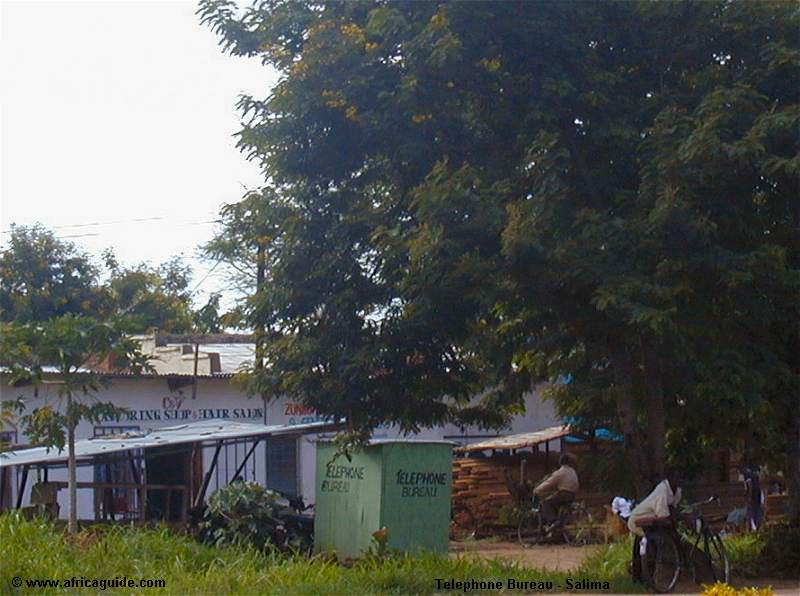
Then through Salima, which like many Malawian towns consists of some shabby garage-like buildings, some of which grandly announce themselves as shops or restaurants. Photo in Salima. and another
From here the road becomes pot-holed to the Livingstonia Beach Hotel. At the gates to the hotel we are allowed in because we are one of: white, rich Asian, or very rich African. We eat a European-style curry for lunch served by black chaps in white shirts and black trousers, looking rather like Black-and-White Minstrels. Malawians are very dark-skinned, perhaps among the darkest in the world.
We walk along the beach, watching a gang of Malawian men who have been commissioned to clear some driftwood that has been washed ashore. They carry it off to the trees somewhere. At knocking-off time, each man seems to have been allowed, or possibly hasn’t, to take home all the wood he can carry, so they file away, each man carrying a branch of a tree on his shoulder or on his head.
In the garden of the hotel we watch yellow weaver birds flying in and out of their hanging nests.
It begins to get dark as we drive home, which increases the hazard-potential greatly as goats and dogs wander across the road, and many Malawian cars have few if any lights.
The story continues with A Trip to Liwonde National Park.

A Trip to the Liwonde National Park

Off On Our Own Today – Malawi, 15 January 1996
Our fifth day in Malawi. This page follows on from A Day at the Seaside, Malawian Style. Today we have the use of a borrowed pickup and have been booked into a tourist lodge in the Liwonde National Park on the Shire River. First we have to drive to Liwonde and stay there overnight in a hotel.
Off on our own in the borrowed red Nissan pickup that is affectionately known as the fire engine. Back along the Salima road and then turn off onto another long, new motorway, practically empty except for the hordes of hard- or soft-shoulder pedestrians. We see a man walking barefoot and carrying his shoes, nineteenth-century Irish navvy style, and a number of women balancing rolled umbrellas on their heads, it having recently stopped raining. Many of the women carry buckets of water on their heads and when you pass a well there is usually a queue of women with their galvanised buckets, waiting their turn at the pump.
Once or twice we see a man walking a pig along the hard shoulder. Often we pass a couple of little boys, less than 10-years-old, who appear at first sight to be playing on the hard shoulder, but are actually minding a herd of goats in an adjacent field.
We comment on how cleanly-dressed many of the people are, though they live in a mud hut and possibly only have one set of clothes and those second-hand.
Intercity. The driver is indicating to pull out. We hope he’ll wait until the door is closed.
Intercity. (Smaller road, no white lines.)
Intercity.
We travel along the motorway and pass numerous buses, many of which are in Stagecoach livery and are marked Intercity. This surprises us but subsequently we see from the Stagecoach Group website: Stagecoach was one of the first major transport operators to expand overseas and this period [1980s] saw it run its first services outside the UK after buying UTM, the major bus company in Malawi.
Most of the buses crab extraordinarily and belch out black exhaust. (It says on UK Business Park UK Activity Report 1997: Stagecoach is selling its 51% stake in Stagecoach Malawi to Admarc Investment for a nominal sum. Now I wish I had taken some more photies.)
More about buses in Malawi at ndagha.blogspot.com. Oh dear!. Seems that no one manages to run a bus company in Malawi for long. Stagecoach’s ‘nominal sum’ presumably meant they lost money on that venture, though perhaps were pleased to see the back of it. [Next political . . .]
On the road to Salima, the roadside pitches seemed to be primarily selling charcoal and, in one place, tomatoes. In Salima it was fish and samosas, plus some burned corn-on-the-cob. Here on this road it is mangoes. On every corner there is a little boy with a cloth containing a small pile of mangoes, mostly small green ones.
We pull onto a dirt road up to the Mua Catholic Mission to eat our packed lunch. We have been told that there is a picnic spot here, and you cannot picnic by the roadside unless you are keen to attract a crowd.
The Mua Mission has recently begun a museum. It seems that the mission was started by three Catholic fathers from Italy, who pitched their tents round a baobab tree. Why they chose this particular baobab tree is not clear. They presumably must have camped in many other places before they got here. It is a fairly lush place though, with water and a tumbly stream over rocks, and probably not that good for farming, so perhaps people left them reasonably well alone when they camped here.
Anyway, this is where they put their tents round the baobab tree and round that tree they have now built the three round buildings of their museum. The museum is not open yet, but the outside walls have been painted in a very lively manner with images depicting the history of the area, starting with Chewa ‘History of Our Time’ legends, the Chewa version of Adam and Eve; going through wars with the Yao; the arrival of Arabs and slavery; then of the Europeans and their fights with the Arabs; then in 1899 along came these three Italian fathers and erected their tents.
Now, the mission consists of a number of substantial buildings: monks’s quarters; a hospital; various other houses; the museum; and a zoo.
We look at the zoo and it is of the old-fashioned, pre-animal rights kind, with stinking cages, a snake pit, and animals that look rather keen to get out; pacing the bars or looking pathetically unhappy. The animals are all of types that can be found locally so far as we can tell, so they probably see their friends outside and think, ‘I am a loser in the lottery of life’. Presumably they are caught locally and brought in.
The fathers employ a number of wood-carving artists and sell their work. Today is a bank holiday and so the woodcarvers are asleep in their workshop, which is like a park grandstand, open on all sides, but one of them comes and does his bit to explain the history via the wall paintings. We buy some carvings.
Mua is the first of a string of Catholic missions we pass on the road, the churches getting obscenely grander as the people seem to get more ragged.
We join the M1, Lilongwe–Blantyre motorway, then leave it again and meet more potholes. A potholed tarmac road is worse in many ways than a dirt road, at least in the latter you expect a slower ride and do not hit holes in the road with such jarring force. We are cautious, we drive to drive round the holes, unlike the string of Mercedes’ with tinted windows and Malawian flags on their wings, for whom slowing down at all would be a slight to their occupants’ fragile feeling of self-importance. They slow down for nothing and no one: potholes, goats, children, they ride over them all at about 80mph.
We come to Liwonde and turn onto a dirt road between stalls of street-traders and people walking this way and that, and arrive at the Kudya Discovery Lodge Hotel.
The Kudya Discovery Lodge is African-run and smells of wee. It has a swimming pool but the water is too dirty to see the bottom, and by the pool is a bar, a dark and dingy shed where your seating is upturned beer crates.
The setting is wonderful and we go to the ‘Hippo Bar’ which has circular openings on three sides giving a panoramic view of the garden and the Shire River, with cool breezes while you swallow your drink.
But the seats in the bar have faded covers stamped: ‘Kudya Discovery Lodge, Liwonde’ and they are not all in position, some of the backs lying upturned on the seats.
The ambiance is dark, not helped by the lighting which consists of a number of 60-watt bulbs held at the end of cables dangling from the ceiling, some with lampshades some not, some working some not.
Each beer you buy and every meal you take, including breakfast, has to be paid for individually to the waiter, which meant that both he and I very soon ran short of change.
We weren’t too sure about dinner but they seemed to be expecting us in the dining room so there we went for chambo and chips. Chambo is a Lake Malawi fish. It was not clear to us whether chambo was a particular type of fish or a generic name for a fish-shaped fish. We have subsequently discovered from Islam Online of all places that chambo is a type of fish, that chambo and chips is one of Malawi’s popular dishes and visitors are told that they have not visited Malawi if they have not tasted chambo, ‘which graces the menu of almost every restaurant, lodge and hotel in the country’.
Islam Online also tells us that in 2003 the stocks of chambo were diminishing alarmingly, mainly through overfishing, and that there was a ten-year strategic plan in place to ensure their survival. News from Africa also reports this story. In 2008, Goliath Business News reported that the authorities were still struggling to restore chambo stocks – getting nowhere by implication. Various other reports, eg IPS indicate that Malawi has an environmental challenge on its hands that it is failing to deal with effectively, or at all. [Next political . . .]
The chambo we are served tastes OK, probably better for having been well salted, and the chips taste like chip shop chips of the 1950s, possibly cooked in lard?, so we ask for a second helping. Malawians must think the Brits gross, for finishing a meal and then asking for chips.
Dessert is lemon pancake or ‘white cake’. We try one of each.
The lemon pancake tastes like those that mother used to make, simply a thin pancake with lemon juice and sugar on. The white cake is a plain, bready, cup cake.
We go to bed in a philosophical frame of mind, having cold-showered – no hot water – and switched of the clattering wall fan – we have already changed rooms because the wall fan was not working in their original choice for us. At least tomorrow morning’s boat is booked. A man came to check if we needed one, then a lady with an English accent phoned to say, no problem.
The story continues with By Boat to the Mvuu Camp Lodge.

By Boat to the Mvuu Camp Lodge

Along the Shire River to Mvuu, Malawi 16 January 1996
Our sixth day in Malawi. This page follows on from A Trip to the Liwonde National Park. We start from the hotel at Liwonde and go up river to the Mvuu Camp, arriving in time for lunch. After dark we are taken out in a truck to look for wildlife.
At the Kudya Discovery Lodge Hotel we get up and breakfast on cornflakes, toast and jam plus fruit salad. No shower this morning, the shower now has no water at all, hot or cold. The bread tastes fatty and doughey, just about edible, and the fruit salad very strange, all the fruits squidgy in a watery liquid. Coffee came eventually but as the waiter explained with apologies, they only have one teapot and someone else was using it. No coffee pots, coffee is served in the teapot which seemed to have a rather severe blockage in the spout – we didn’t investigate.
While we sat in the lobby a man walked through with a laptop computer – most incongruous for Malawi – and this led us to discover that the hotel was hosting a training course for science in primary education – important-looking African chaps in shirts, slacks and sandals, some in new trainers, a motley assortment. We wondered what would happen at coffee time.
Then down to the river to board the expensive river boat to Mvuu Camp. A boat all to ourselves except for our Malawian boatman guide. We sit on crumbling wooden armchairs on the flat deck of a double-canoe catamaran.
The boatman points out all the birds and animals on the way. There is a surprising amount of hippo in the river. The boatman sees them and steers clear. From time to time the outboard motor runs out of petrol, so the boatman disconnects the feed hose and plugs in one from a different jerrycan.
There seem to be a lot of crocodiles too, again a surprising number. The boatman, who looks to be about eighteen-years-old, appears to be very knowledgeable about all the birds and is obviously reasonably well educated.
The boat ride takes about three hours. The weather is cloudy and threatening rain, and windy. We discover later in the day that our faces and legs have become quite sunburned, even though we were under the shade of the boat canopy all the way.
We paid the boatman a vast load of kwatchas and disembarked, arriving at Mvuu Camp in time for lunch. There we meet two Aussies who were in our hotel last night. We had thought they were South Africans because they looked so stroppy and miserable in the hotel, but no, now they’re here they are smiling, garrulous Aussies. They got to the camp before us because they came up by road. They enquired about a boat but were told that, since they were the only people travelling the boatman could only take them half way and them bring them back, so they paid someone to bring them up in a jeep. Possibly this was a cost thing. Both we and they had seen elephants on the way up here.
These boys aren’t too ragged, perhaps they’re just practising.
Coming up by boat we had had the opportunity to watch ragged-looking fishermen in dugout canoes, casting their circular, weighted nets into the river. We were told that, from where they were fishing, they would only find mud-chambo, which was not a good fish to eat. We later discover that these people were relocated from the area that is now the national park in the 1970s and are forbidden from taking fish from within the park now. A modern-day clearances, but instead of for sheep, for tourists and wildlife conservationists. The river in the park holds good chambo.
We eat a well-presented buffet lunch of the type we did at Oakdene, with salads and ham and cheese, and are shown to our tent.
In the evening, before dinner, we are all taken for a drive in a converted truck to look for wildlife. This lasts until after dark. We see genet and spotted eagle owl, elephant and hippo, bush hare and impala, by the light of a searchlamp on the truck, operated by a Malawian named Fred. Under a big, wide, starry African sky. Our travelling companions are a VSO girl from England and three smoking surly South Africans.
Then back to the camp for dinner in the darknesss outside at a communal table round the camp fire. I am reminded of the Spitting Image song, ‘I’ve never met a nice South African, and that’s not bloody surprising mun, for we are a lot of ignorant bastards with no sense of humour’ See the YouTube video, if it’s still there – the song can evoke some vitriolic complaints.
Back to the tent to find a gecko on the wall near Hilary’s pillow. Swap beds.
The story continues with At the Wildlife Camp.

At the Wildlife Camp

A Day at Mvuu Camp, Malawi, 17 January 1996
Our seventh day in Malawi. The follows on from By Boat to the Mvuu Camp Lodge where we arrived yesterday. Today we go for a walk in the bush, the sit and watch the animals from in the camp, talk to the owners, and see a lioness after dark.
Up at five for a walk in the bush starting at six. But it’s pouring with rain, so the scout doesn’t arrive. Fred the warden is here, but no scout. Why do we need a scout?
We have our breakfast, the rain begins to ease, then Fred tells us that the scout has arrived. So we go for a walk in the national park. We need the scout because he carries the gun.
Fred the guide seems to be disappointed on our behalf that we see no elephant or baboons. In the dry season, he says, you see lots of animals because they will go to the water’s edge. We don’t mind. We learn about trees and tree frogs – see their eggs in foamy clusters suspended from branches overhanging stagnant ponds – that’s one of the main reason the frogs climb the trees, so they can lay their eggs in a conveniently protected position.
We listen to Fred’s peculiar English which randomly intermingles L, R and W sounds. And we think, that those who dispute the perversity of life as a given fundamental, they don’t know nuffing, they have never been privileged to meet Fred, who can prove it, for he is a Malawian who is required, quite a few times each day, to say: ‘red-legged pangolin’.
We learn a little bit about Fred’s life and that of the Africans who work here, though only a little bit as he is rather cagey about it all, just occasionally letting something slip such as how, when a boy, he used to find lots of tadpoles when playing in the stagnant ponds (these would be the tadpoles of the tree frogs, that had fallen from the frogspawn in the trees).
For the rest of the day we sit in the tent porch, from where we can see more animals than on any bush walk or safari drive. We watch a family of hippos lumbering along the riverbank, with birds on their backs eating the ticks and lice and leeches that have presumably clung themselves to the hippo in the water, since hippos spend most of their day in the water.
We watch enormous crocodiles floating along the river like part-submerged logs. Bright yellow weaver birds, giant and pied kingfishers, fish eagles, enormous millipedes on the flysheet, blue-throated lizards looking about angrily, orange thrushes, blue waxbills – many of the birds are brightly-coloured.
In the water the hippos yawn and make a noise like a donkey practising the tuba. Except when a motor boat takes workers to the village on the other side of the river, everything is quiet but for the tinkling water and birdsong.
The people who run the camp, Norman and Sue, are South African. We have learned from our fellow-guest VSOer, who works at the Kusungu National Park which is further north not far from the border with Zambia, that the development of places such as this is primarily financed by grants and sponsorship. It seems that the EU is putting money into a project to develop a visitor centre at Kusungu.
Here at Mvuu, Norman and Sue have plans to build a swimming pool and to change from tents to chalets with en-suite bathrooms. Upmarket it to attract higher-spending tourists. The visitors at this time of year are mainly South-Africans with ugly, dipthong-laden accents; instead of saying yes they say: ‘yeeaah’.
In the evening Hilary is feeling ill as she has been for most of the day (probably a result of the Kudya Discovery Lodge Hotel, we suspect) so she cancels dinner, but we go to the bar for a drink and one of the safari guides is there and he says: ‘Want to come and see the lions, they’s been reported by the rhino fence’. (An area has been enclosed by electric fencing, 15,000 volts says Fred, though this seems a bit on the high side to us, overhead cables on railways in many counties of Europe are in the region of 15,000 volts. Anyway, a pair of rhinos have been imported from Kruger National Park in South Africa, there seems to be no certainty that rhinos have ever existed in Malawi before).
We all bundle into a safari truck and drive out to see the lions, Ian the white safari guide driving and Fred the black warden working the spotlight. We spot a lioness and cubs and follow them around for a bit. Then we drive back for dinner where I am last at the table, Hilary asleep in our tent, and have been left a place next to the three miserable-looking and smoking South Africans, who turn out in fact not to be South Africans, but of that other country where the people have a (largely deserved) reputation for being generally stroppy and humourless: Israel!
The smoking Israeli/South Africans are keen to talk politics, which suits me fine, far preferable to the frivolities that the rest of the party seem intent on, though Ian the ever-enthusiastic safari guide does catch a cicada and demonstrates that by tapping it expertly you can make it play a tune of your choice.
No gecko in the tent tonight. We caught the gecko earlier and threw him out, both with some difficulty as he was not easy to grab and moved very fast.
The story continues with From Mvuu Back to Liwonde.

From Mvuu Back to Liwonde

A Chat, a Boat Ride, a Boy Killed by a Crocodile, Malawi 18 January 1996
Our eighth day in Malawi, this follows on from A Day at Mvuu Camp. We swap hotelier tales with the proprietors and then return by boat to Liwonde, the boatman is most upset about a boy killed by a crocodile.
Up early, breakfast and pack ready for the boatman due at 10, who arrives at 12. We spend the time talking with Sue and Norman, the proprietors, who get ultra-interested when I give them a picture of Oakdene. Stone-built, old, manicured gardens, that’s what they like. They are smoking South Africans. Sue introduces most sentences with an aggressive-sounding: ‘Look’.
Norman thinks he would like to buy our place and staff it with Malawians, who are he says both hard-working and cheap. Of course he’s never been to Britain.
The camp is leased from someone, presumably the Malawian Government, by African Wilderness Safaris, Sue and Norm were the managers and are now the managers with a ‘shareholding’, which we understand to mean a performance-related profit scheme. The building and the site’ fixtures and fittings were donated by the South African government.
Sue and Norm seem to be attracting income which they are using to develop the place. They have been here for two years. Last year they have only four days when they were completely empty. They aim to be the best in Malawi. They market primarily by letting the ex-pats know they’re there. The ex-pats use the place themselves, but more to the point send their visitors there as it is one of the few decent places to stay (which is essentially how we come to be there). Sue and Norm’s lease is for five years. Norm is clearly looking to the next stage of their life and contemplating mad ideas like importing cardboard coffins. Death is frequent in Malawi, and everyone wants a coffin.
Sue and Norm’s non ex-pat clientele comes from all over the world, mainly people on African Wilderness Safaris, where they stay one or two nights in various places.
The food at Sue and Norm’s is a set dinner and help-yourself lunch of bread and salads. The question for us, from our Oakdene experience, had to be: ‘Do you get many who “can’t eat” this and that?’. ‘No’, said Sue, clearly not seeing it as an issue, simply saying that she was sensitive to vegetarians and those whose religion forbids pork. Well, well, well.
Then the boatman comes and rides us back to Liwonde. He is most anxious to tell us about the incident yesterday where a nine-year-old boy was taken by a crocodile while playing at the water’s edge. They took out the boat and borrowed a fishing net but could not catch the crocodile before it let go of the boy and swam off. They fished the boy out of the water but he had lost too much blood and he died.
Fishermen in dugout canoes continued to wade in the water – some to pick up fish cages from the shallows and empty the silvery little fishes into their dugouts.
The story continues with Liwonde to Zomba.

Liwonde to Zomba

We go to Zomba and are Poisoned by a Pork Pie, Malawi 18 January 1996
This follows on from From Mvuu Back to Liwonde. We drive on to Zomba, stay in a grand hotel, and are unimpressed.
On arrival back at Liwonde we find our borrowed pickup where we left it and we drive over lots of potholes, up the hill, to Zomba.
Into the market to look around. See men making buckets. Buy tomatoes, cucumbers, mangoes. Look at the stinking piles of dried fish. Women selling rice from a wicker pan. Toys made from scrap metal and plastic. A stall repairing and selling old shoes.
Zomba is a university town and there are youths in gowns – perhaps it is graduation day. Their shoes are obviously their pride and joy – trainers with the tongues pulled forward a la Brixton.
We buy bread in a supermarket – selling like hot cakes – freshly baked white bread, every loaf bought as soon as it is placed on the counter, but we buy the more expensive brown bread. And a Chelsea bun for Hilary, flavoured with cloves.
Then drive on up on a windy potholed narrow road, up and up past sawmill, forests, and the ever-present people walking, to Ku Chawe Inn.
We arrive at the same time as an African Wilderness Safari wagon which disgorges four Austrians. I talk with the Malawian driver as the Austrians go to check in. He has just driven them from the airport at Lilongwe – a four-hour ride at the end of their air trip, from wherever that was – they look pretty zonked-out. Tomorrow he will drive them to Mangochi. The driver says it took him longer than he would normally do from Lilongwe because he had to drive ‘safely’, he said with some evident distaste.
We look around the manicured gardens overlooking the valley, have a drink in the posh hotel bar, and eat a mediocre dinner in the restaurant surrounded by flunkies. We cannot resist one of the starters in this classy restaurant, which is described as ‘pork pie’. Our dinner consists of chambo covered in tomato and onion, and chicken in a nondescript sauce.
The Austrians are in the restaurant dressed in safari suits – khaki gear from Vienna’s best shops. We spend a fair amount of the night in the toilet.
The story continues with Zomba on the Plateau.

Zomba on the Plateau

A Day at Zomba, Malawi 19 January 1996
Our ninth day in Malawi, this follows on from Liwonde to Zomba. We search for some sanitary products, eventually finding Sainsbury’s, well sort of, then we go for a stroll in the bush and meet a baboon.
Hilary has a period and has left her tampons in Lilongwe. After our English-style breakfast served by flunkying Malawians in the Ku Chawe Inn hotel we bounce down the dirt road to Zomba town, having first baffled the Malawian receptionist by our needs, but been helped out by a UNFPA (United Nations Population Fund) worker who had been having an important discussion meeting in the expensive hotel. The pharmacy seemed to be what we wanted.
Where is the pharmacy? We ask a youth dressed in university robes and casj (as in casual) trainers. His instructions were imprecise, though he obviously knew where the pharmacy was and wanted to be helpful, he was just not practised in giving clear instructions.
Hilary went to ask in the doctor’s surgery, which being a private clinic was completely empty. The smiley African doctor gave equally unclear instructions, but at least gave the name of the shop, which turned out to be exactly opposite – the doctor had given instructions from the road junction, not making it entirely clear which direction or which side of the road to look on, rather than directions from where we were at that actual moment.
In the Indian-run, spotlessly clean pharmacy, Hilary could not resist one of the brands of press-on towels on offer: Sainsbury’s! Quite how products from Sainsbury’s came to be on the shelves in a pharmacy in Zomba was a question we thought it politic not to ask.
Then into the market to buy an African skirt, ie a wrap, choosing good sense over fun and not buying the cloth that was printed with pictures of Mozambique banknotes.
We should buy some tapes of Malawian music. Ask at a stall. The youths play us some examples on their cheap plastic Brixton briefcase, assuring us that the songs are in Chichewa and by Malawian bands, we’re not so sure though. They press us to buy gospel and religious music, presumably because that is what they think we should like.
Having bought a couple of tapes for 30 kwatchas each (about £1.25) we look at another stall selling tapes and discover we have been done. The tapes we bought were pirate copies. The originals can be had for 35 kwatchas.
Back up the hill to Ku Chawe, where we sit on the balcony of our room to read and watch the man take about forty-five minutes to tidy our room, and still only leave us with one handtowel and a bathmat.
Then we put on our walking boots and go for a walk on the Zomba plateau, which consists of undulating hills high up. We run the gauntlet of the carpark attendant, who wants to chat the afternoon away, seems to be hoping we’ll buy him an air ticket to the UK.
We follow paths through the forest, by smoky African hut dwellings, eventually getting lost, or rather taking a path that seems to be heading off in a completely different direction from what the map shows. The map cost us thirty kwatchas in the hotel, £1.25 to us, more than a day’s pay for a Malawian teacher.
We retrace our steps and find a path that is definitely on the map, driveable except for the fallen trees. We round a bend and there in front of us on the path is a big, red-mouthed baboon. Will he move out of our way or attack us? Pick up a stick and shake it at him. He lopes off into the bush. We see him sitting on the hillside, looking left and right lordily.
Cor!
Passing poverty-struck loggers’ shacks – probably not official loggers, probably they pick up whatever bits of wood they can find or chop down illegally. Then we suppose they put a bundle of sticks on their head and walk it down to Zomba to sell as firewood. We see the bundles of sticks, just about at the limit of liftability.
We walk down the forested path by cataracts, but it is threatening rain so we do not linger but march back to the hotel. Men are pacing about in forest clearings, we guess looking for mushrooms, but could be all manner of things.
We were intending to skip dinner but go for it anyway. Pretty terrible.
The story continues with Zomba to Lilongwe.

Zomba to Lilongwe

A Ride Back to Our Base, Malawi 20 January 1996
Our tenth day in Malawi, this follows on from Zomba on the Plateau. We drive back to Lilongwe in the fire engine, stopping for lunch in Mozambique, and meeting a fat English slob at teatime.
Today we are driving back to Lilongwe. We pack up the fire engine with conversational help from our new-found friend from yesterday the carpark manager in his shirt and tie. He shows us some banknotes he has been given as a tip. Are they of any value? They are Argentinian and Uruguayan, how unkind. Some South Americans have been at the hotel on a Wilderness Safari. Mike the South African catering manager from Mvuu has been driving them round the Zomba Plateau as part of their ‘safari’. He looks pretty fed up with the whole business.
(We’d met Mike at Mvuu. He was a perfect catering manager: large, personable and clearly a lover of his food. That he was guiding safari trips was a feature of the management roping-in whoever was available as needs must. Mike knew only a patchy outline of the wildlife and other things generally thought of being attributes of a safari guide; he told us of one occasion when he was showing round a party of Japanese Wilderness Safari attendees and, short of a credible-sounding description for anything currently in view waved his arms in the air and exclaimed grandly: ‘Wide African sky!’, at which point the Japanese all pointed their cameras upwards and clicked away at pictures of: yep . . .).
The fire engine at a panorama point.
We drive on the dirt roads to visit two panorama points named on the map as ‘Emporer’s View’ and ‘Queen’s View’. The roads are bumpy and overgrown with grass in places, but we get through. Little boys at Queen’s View are selling ‘smoky quartz’, who to, we do not really know, perhaps they might get four tourist jeeps passing per day if they are lucky.
Back down off the plateau on the dirt road. In one of the slower sections little boys wait to ask for kwatchas. One boy runs alongside the pickup in bare feet over the uneven rocky surface for about half a mile, saying repeatedly: ‘Give me ten kwatchas’. Today is Saturday and the children are not at school.
Back along the M1 motorway, being overtaken by trucks, buses and cars, especially on the downhill stretches. Through towns of bustling markets. Past bush taxis trying to cram yet more people in at the roadside. Numerous women with buckets of water on their head, some of the buckets leaking rather seriously. I am getting quite adept at avoiding potholes.
The scenery changes – gets more mountainous. The map shows we are close to the border with Mozambique.
We pull off the road for our lunch of bread and tomatoes that we bought two days ago, surprised at not being passed, stared at and spoken to by people. There’s no one about. We eat lunch uninterrupted until just as we are packing up our bags a little boy comes and stares at us. We discover later that we have been eating lunch in Mozambique – the road is the border. Most of the villages are on the Malawian side of the road, though people are being encouraged to move back into Mozambique now that the civil war is over so there are now a few villages there.
We press on along the road until we get to Dedza, where there is a pottery.
A fat slob Englishman with a north-of-England accent, beer belly, too-short nylon shorts, and glasses that change colour when someone throws the light switch, is trying to order some pottery. The Malawian salesman seems to be unable to handle the idea that Slob will phone him from Mzuzu and place an order for more plates. This is altogether too new to him.
Coffee at Dedza.
We steer well clear of Slob. When he’s gone we buy some pottery. We order a coffee and cheesecake to eat in the café garden. Seventy-five kwatchas for coffee and cake for two: 2–3 days salary for a Malawian teacher. For us, excellent value as the quality is good.
Then back in the fire engine to Penny and John’s, getting lost in Lilongwe in the final stretch, so arriving in a very jolly mood.
The story continues with Of Dogs and Tears.

Of Dogs and Tears

Problems of Conscience, Malawi 21 January 1996
Our eleventh day in Malawi. This follows on from Zomba to Lilongwe. Barbie and Ken turn up at the house thus throwing Penny into a state of remorse; we learn about what a hornets’ nest Penny and John entered when they came here and how their dream of doing a little good for the world is inevitably going to be shattered. And we take the dogs for a walk.
Today is our slob-out day. It starts off well, with an idea to go to a German restaurant for lunch, if the road is passable. But the restaurant turns out to be closed for January.
We are sitting on the khonde thinking of alternatives when the gate is opened by the guard (white men do not, as a rule, open their own gate) and in comes an SOS vehicle delivering Barbie and Ken. All smiles, they have got the job. They regale their story to Penny and John. How they got to Harare but found no one to meet them. They had no money but managed to talk someone into letting them use the telephone and eventually got collected and taken to the SOS Children’s Village. The following day they were flown to Gaberone for a meeting with the SOS Africa boss who offered them the job and lent them a vehicle to drive back to South Africa for a few days. Then back to Gaberone, then Harare, then Lilongwe, still with no money. Barbie’s greatest delight in this episode is to have been treated to an evening drinking Southern Comfort.
John eventually got them up to the SOS Village, avoiding laying on any lunch, getting away solely with a glass of ‘celebratory’ whisky.
Then Penny cracked. She feels like Judas, selling her SOS children into the hands of these fascist racists. Barbie still has Penny’s dress, that Penny had lent her to go to her interview. When she gets it back, Penny will burn it.
Why has Reiner, their boss, fallen for these charlatans? Barbie has already says she wants the dogs to be disposed of as they will not match her poodle. Penny is distraught.
But perhaps Reiner is right. We hear more of the story of SOS Lilongwe.
SOS Children’s Village built their Lilongwe village at a most insensitive moment, at a time when aid to Malawi had been stopped, partly under the influence from the Catholic Church in Malawi, in order to force the president, Hastings Banda, to declare democratic elections. The driver for this was the desire to see redistributed some of the money that Banda was spending on lavish palaces for himself and academies based upon Eton College for the sons of his elite.
Then in comes SOS and builds a village for orphans. Mrs Banda, the president’s wife, organises a great opening ceremony, publicised to the world, paying anyone who will turn up a kwatcha each to wave a flag. Penny and John walk into this from the UK to set up the first SOS Children’s Village in Malawi, all unknowing and innocent.
Penny and John’s job, having got the building erected and equipped, is to take in orphans, that is what SOS Children’s Villages are there for. They are aware that they need to be very careful not to be accused of child stealing. They want court orders if at all possible.
The Malawian social services are however unwilling to cooperate. Take-on of children is slow, too slow for the authority in Innsbruck’s performance measurement statistics. (SOS Children’s Villages headquarters is in Innsbruck).
Then as people see the village taking shape and social services see the conditions there, seeming like a holiday camp compared to what large numbers of Malawian people endure, they begin sending along ‘orphans’, all of whom are, what a coincidence!, related to people who work in Malawi social services.
Is this an issue in Harare or Gaberone? Probably, who cares? The numbers are up and philanthropically-inclined folk in Reykjavic or Oslo can feel righteous and involved. Who cares? Penny and John do, But Barbie and Ken quite probably won’t even notice that the orphans have surprisingly well-connected parents lurking away somewhere, after all they’re black aren’t they? They need caring for then. So Reiner is probably right, and this too explains John’s phlegmatic approach when Barbie and Ken first appeared on the scene. This is Africa. Please don’t rock the boat.
Penny and John have to walk away from it. It was a grand mission but too naïve and doomed, we now see, to failure. [Next political . . .]
And the dogs will have to die too, be put down, because they might upset Barbie’s poodle and so be put out on the street, so it is kinder if they are destroyed. But maybe some of the other Brits in Lilongwe might take them, look after them.
Einstein and me
We take the dogs for a walk to see whether any of the neighbours might take them in. African dogs are not taken for walks and it takes these three a while to get used to it. A few choking attempts and barking and getting tied up around people’s legs but they get the hang remarkably quickly. In an extraordinarily short time they are on the leash like it is their favourite way of passing the day.
As a rule, Africans are rather scared of dogs and the people in the street stare at us and keep a very wary distance, as if we were the local leather-stud set taking our rottweilers out – or our pit-bulls, which indeed one of them is. We pick up rocks to throw at any wandering dogs that come our way, but none do, or perhaps they have more sense than to attack a pit-bull, or perhaps it is just chance.
The neighbours say: put them down. It’s kinder that way. They then regale Penny with who has gone off with whom – the ex-pat community of Lilongwe, it’s just like home.
Not a jolly day. A day of tears.
The story continues with To Mzuzu on the Bus.

To Mzuzu on the Bus

A Bus Ride to Mzuzu and Our First Meeting with Lead Fart and Lawnmower, Malawi 22 January 1996
Our twelfth day in Malawi. This follows on from Of Dogs and Tears. We go to stay with some of Penny’s relatives in Mzuzu and we travel there by bus, and we get introduced to Lead Fart and Lawnmower, who will be significant periodically in the rest of our stay in Malawi.
Today we are taking the bus to Mzuzu. First we go into town in Lilongwe with Penny and John to change money at the bank, buy postcards, and buy some malachite to take home. We bargain a little and buy bracelets and earrings for 500 kwatcha – eleven bracelets and a pair of earrings for £22, seems OK to us. Then a man tries to sell us a further five bracelets for a price dropping to 80 kwatcha. Should have bought them. ‘Oh, spit!’ cries Penny in her girls’ school English. ‘Oh, spit.’ Penny reckons we could have got the lot for a quarter of the price and that we’ve been done.
Then we pack the bags and drive with Penny and John to the bus station. We watch the combi vans pull up, the sliding door opens and about a hundred and fifty Malawians tumble out. These are the local buses. Most of the minibuses are Toyotas, often the sliding door does not close properly having pressed on too many bodies too often.
The Mzuzu bus arrives and we bundle on, getting ourselves a rather collapsed plastic-covered seat for the four-and-a-half hour journey. Our tickets have seat numbers on them, but we are not too surprised to find no one taking any notice of them.
The bus drives through the embassy district to the Capital Hotel to pick up business-type Africans in suits and deodorant. Then to the airport, then off down the road at full belt: 5mph up hill and 95mph down, hooting cyclist and pedestrians off the road, occasionally being obliged to slow down for an ox cart or turning Carlsberg lorry.
We pass two checkpoints where soldiers get on the bus to check passengers’ credentials, one of these checkpoints is right alongside the Zambian border. At this stop, people get off to buy hard-boiled eggs, barbecued maize and cooked chicken. Drinks and crisps are available in the bus from the smiley steward. Coke for 3.50 kwatcha per bottle (15p).
The road becomes much more deserted of people as we climb through wooded hills – on one of them a paper-making venture.
It starts to rain, giving the African passengers the excuse to close all the windows and so steam up the inside of the bus, making everyone feel sleepy including, we rather worryingly suspect, the driver. Certainly he had not changed the tape lately. Music has been played in the bus the entire journey. It started off all right with blues, then degenerated through smoochy piano to end up on Country and Western. Aargh!
We arrive in Mzuzu in one piece thankfully, to be met by John and Gillian and Lead Fart and Lawmower. Penny and John had warned us about the latter two and they were right.
Lead Fart and Lawnmower were visiting from the UK. They had first stayed with Penny and John in Lilongwe and were now with John and Gillian in Mzuzu. During their time in Lilongwe they had gained the nicknames of Lawnmower and Lead Fart (unknown to them, we hope and assume). Paul, aka Lawnmower, had something wrong with his face, which had caused Rusty at the SOS Village to remark that he looked like he had been run over by a lawnmower. Jane had got her nickname from Penny, whose girls’ school English had remarked that when you talked to Jane everything you said went down like a lead fart. So they were Lead Fart and Lawnmower.
Lead Fart tries to get every conversation round to the mundane, primarily to prevent it from getting out of her not substantial depth. She can be quite rude about it – all done in a supposedly upmarket south-of-England accent.
The first evening we were in Mzuzu they were discussing why a Malawian car mechanic, who had been on a course in Bedford including some work at the Vauxhall plant in Luton, still can’t fix a car with any evidence of commitment to the project. I suggested that perhaps he was there in the 1970s, when there was a fashion for sabotage of anything smacking of official systems. ‘We didn’t sabotage things in the 1970s’, announced Lead Fart indignantly. To which the answer was: ‘I know you didn’t dear, you weren’t a bloody motor car mechanic working for Vauxhall Motors, were you!’ But the damage is done before I get a chance to respond, the thread is broken, others rush to her rescue and change the subject. Any whiff of intelligent conversation killed. On the other hand: ‘Oh, what pretty flowers. Aren’t they pretty flowers!’ keeps her going for hours.
So the evening was made bearable largely on gin and tonics. At least Mr Lawnmower is not too bad, just rather boring, not surprisingly really since he commuted from Dorking to London every day for forty years for the same company.
The story continues with Florence Nightingale Wasn’t a Nun.

Florence Nightingale Wasn’t a Nun

A Market, a Hospital, a School, a Seaside. Malawi 23 January 1996
Our thirteenth day in Malawi. This follows on from To Mzuzu on the Bus. We visit Lady Margaret, then a school, then the market, then a hospital, and finally the seaside where I succeed in upsetting Lead Fart again.
First today we drive from John and Gillian’s house up the hill to visit Lady Margaret Roseveare. Lady Margaret is the second wife of Sir Martin Roseveare, who helped to establish the education system in Malawi after independence. There is comment on how the fruits of his work have unfortunately not been upheld on Dereliction Express. Martin Roseveare died in 1985 aged 87, Margaret was somewhat younger, in 1996 when we visited still only 83. She has stayed-on in Malawi as something of a grand dame.
Lady Margaret is attended by three servants or ‘houseboys’ named Watson, Godwin and Boyson. Watson has been with the Roseveares for decades, Godwin and Boyson are brothers. Godwin works for Lady Margaret, Boyson his brother is currently is seconded to John and Gillian. Boyson is paid the going rate by John and Gillian, Watson and Godwin much less, as Lady Margaret’s rates are of a bygone age. Boyson is concerned because his brother says he will kill him for being paid more, and in that way putting his brother down so. But is Godwin really being paid less? It seems that Lady Margaret’s accounts are not necessarily reflecting the true state of things, or so we are told later. High intrigue!
We see Lady Margaret’s garden, her no-longer-functioning swimming pool. We ooh and aah over her pretty flowers (or at least some us do).
Next we visit Lady Margaret’s school, a fee-paying school which will be used by better-off Malawians. We meet the head. ‘You are most welcome’, he says. We see the nursery children who sing for us, songs taught to them by Gillian: ‘De wheels of de bus go round, round, round’.
Malawian children learn everything by rote so when you are shown into a class all the children stand up and say: ‘Good morning, how are you. I’m fine thank you, how are you?’ in unison.
Then we go to Mzuzu market with Gillian. Buy red bananas and chilli bombs. See the piles of stinking fish, the piles of Oxfam-reject clothes, the charcoal sellers, the African doctor. We visit a couple of Indian stores piled high with all sorts of stuff from frilly underpants to gaudy ghetto-blasters.
The reason why John is not with us is that he has gone to the hospital. John is a retired GP from Capel near Dorking who is doing his bit of good for the world before finally hanging up his prescription pad and has come to Malawi in order to do that social duty. Gillian, like Penny, is related to the Roseveares. Today John’s job is to perform a surgical operation on a man who has a beetle lodged in his ear. John is somewhat apprehensive about this as well he might be. We are to meet him at the hospital late morning.
We go to meet John at the hospital. We see the wards with people lying, mostly dressed, on grubby bedclothes. We see children dying of malaria. Nurses washing-out rubber gloves for re-use – and hanging them out to dry. People on traction made of metal bars and improvised weights. This is one of Malawi’s better hospitals. People pay to come here.
People are sitting around on benches looking miserable. They might be hungry. Food is provided by relatives.
Posters show a picture of the pope with the message: ‘Put Your Faith in Christ’.
The hospital is run by the Medical Mission of Mary; Irish nuns. They are trying to hand control over to a committee of local trustees as they are finding it difficult to recruit sufficient novices for missionary work and they need to concentrate on smaller clinic ventures.
John cleaned out the man’s ear and thinks the operation went quite well. We go to find the man to see how he is doing. But he has left, gone home.
As we are leaving the hospital a white man asks for the psychiatric unit for his friend. John tells him it is next door. Off he shambles with his friend. The friend doen’t look too bad but the man himself is pasty white. Junkies maybe.
After lunch we all pile into John’s Land Rover, donated by a patient in Surrey, to drive to the beach.
The road passes through rubber plantations and we pass villagers selling bananas of yellow, red and green. We buy some small ones for seven kwatcha (30p), too many for us to eat, probably.
To Sambani Beach where we get a chalet. The electric socket is off the wall in a big way, the sellotape that used to hold it in place has rotted. Otherwise it’s all right, if a bit worrying that the fusebox is in the shower room. We’ll be careful.
We have a flurry of drama getting deckchairs onto the beach in a way that sufficiently pleases Lead Fart. We have a swim in the lake.
We eat a dinner of chambo and chips that could have been worse in the circumstances. I was talking to John at one point about nursing having developed in Europe from the work of nuns and how perhaps this is relevant to the way in which Malawi might be evolving with regard to hospitals and medicine and the like when Lead Fart interjected: ‘Florence Nightingale wasn’t a nun!’, she exploded indignantly. On this occasion, and not least because it was his professional subject area, John backed me up in pointing out to Lead Fart that Florence Nightingale was a pioneer of modern nursing, not the first person ever to nurse. Lead Fart didn’t listen of course, and as the conversation continues she persists in grumbling that Florence Nightingale wasn’t a nun, repeating it periodically to prove that she was right.
A hot and sticky night under the mosquito net.
The story continues with I Used to be a Cisterns Analyst.

I Used to be a Cisterns Analyst

Sunrise, Swim, Turtle, School and Repair the Lavatory, Malawi 24 January 1996
Our fourteenth day in Malawi, this follows on from Florence Nightingale Wasn’t a Nun. We rise at dawn on Lake Malawi. We breakfast on nsima. We visit a school and are tapped for aid, we swim in the lake some more, and get home to find that the lavatory is broken.
We had been encouraged to get up at 4am to see the sun rise over Lake Malawi, so we did. Very pretty, reds and oranges and pinks and purples. There’s something in the lake. An animal, or a log? Must be an animal. Not a croc, not a hippo. A snake? Looks more like a dolphin, too fat for a snake. And then we see it. A turtle. There are turtles in Lake Malawi.
Back to bed for a kip and then a swim in the lake before breakfast, with fishes around our legs.
For breakfast, we try nsima, which is a thin, watery maize porridge. Looks like semolina pudding, tastes of nothing at all.
Malawians live on nsima. They could surely do something more interesting with it than mix it to a paste with water. But they are poor people, and as we know from our hoteliering, poor people like ‘plain food’. Perhaps the solution for Malawi is the same as it is for Cumbria: improve the diet. Probably just as much a hot potato here as it is there.
After breakfast we drive to Bandawe. John and Gillian have 1,000 pencils that they want to give to the school which uses the old Livingstonia church as a base.
The Chichewa Lesson.
Pay Attention at the Back There!
Waiting to be tellt. It did not occur to us at the time, but it seems there are only boys in these lessons, no girls. Whether this was general or whether this was a boys only day we should have asked.
We see classes in progress. In one corner of the room a teacher is holding a Chichewa lesson. In another corner sits a group of children doing nothing. They are waiting their turn with the teacher.
The head of the school comes to see us and shows us round. Choruses in unison of: ‘Good morning, how are you. I’m very well thank you, how are you?’.
The head announces that we have brought pencils and that if the children behave themselves they will be given a pencil. The class applauds in unison. He then tells the class that he hopes these visitors will come again, but next time bring desks, for they badly need desks. The class applauds again. A lesson in international aid.
Outside the class children approach us saying: ‘give me kwatchas’.
We walk down to the graves of the missionaries, who died trying to operate the mission at the turn of the 19th-20th century.
The head teacher catches us on the way back, asks for a donation, which we give, and then for a film for his camera. We give him a film, so he asks for another. Tough luck, mate.
John is uncomfortable about the visit. Wishes we had hung onto those pencils that had been donated by a benefactor in Surrey.
We travel back to Sambani via a small beach where we meet an English beach-bum with feathers in his earrings.
Back to Sambani for a lunch of chicken curry. More swims and reading and writing under a thatched sunshade on the beach. Out on the lake, it looks like there is smoke rising. It looks like someone is setting fire to Mozambique. Lake flies. The clouds of flies move across the lake, ending up in the next bay to ours (fortunately), and causing a smoke-like mantle at the tops of the trees. In the sky are hundreds and hundreds of swallows. The flies do not affect us, though we can hardly see the next bay.
The lake flies are a feature of Lake Malawi, they suddenly appear for no evident reason and swarm in great clouds. We are told that the people net them in and eat them, for while one fly won’t make much of a meal, a large number pressed together in a cake can. We tried to see whether anyone was out there doing the collecting, but in the next bay we couldn’t see anything.
We drive back to Mzuzu through plantations of rubber, macadamia nuts and rice. The rice paddy-fields were set up by the Chinese Agricultural Mission. Now the Chinese have gone the fields look in pretty poor state.
At a village that has a band of bugle and three drums playing for the children to dance to, a man informs us that the bridge is down, so we have to turn back and go the way we came.
When we eventually get back to Rosewood, John and Gillian’s house (owned by Lady Roseveare) the lavatory cistern is broken. It’s not too badly broken and I am able to fix it quite quickly. At an attempt at an improvised joke that has just come to me, I say that it’s fortunate that I was here for I am well qualified to do this job, since I am a cisterns analyst. Lead Fart pompously announces that she has fixed the cistern already this week numerous times. Pomposity shielding how ignorant you are, or what?
The story continues with Shocking News.

Shocking News

We Receive a Phone Call from the UK, Malawi 25 January 1996
Our fifteenth day in Malawi, this follows on from I Used to be a Cisterns Analyst. We receive bad news. And Penny and John have a difficult meeting
On the bus for Lilongwe at Mzuzu at 6am. The bus driver plays Chichewa music – much preferable to the slushy western stuff we suffered on the way up. An uneventful ride, made less pleasant than it might have been by an American who wanted to be our companion, and who had extremely smelly armpits.
We arrive at Penny and John’s house, they are out at work. James comes in after having answered the telephone and says to Hilary: ‘There is a call for you ma’am’. Hilary’s brother Rod is on the phone. Rod tells Hilary that their dad has died.
Hilary decides that there is little to be gained from rushing back to the UK since we are not here for many more days. Rod is plenty capable of handling everything. We carry on as planned, albeit in a state of some disorientation.
A relative of Penny’s called Sofia turns up at the house. She is the posh pronunciation of Sofia, So-fire, not So-fear. We bundle into the fire engine to go and look for material for shirts. If we buy the material the then mother of one of the drivers will make us shirts from it.
We go to a mental handicap centre where the Rotary Club’s overseas aid section had set up a workshop to provide work for disabled people in Malawi. Once they handed the project over to Malawian management and left it went bust. Another aid agency has now pumped in cash, to try and get it going again. We see people magically embroidering patterns on cloth by eye. (Some time later we heard that the centre has closed).
We meet up with Penny and John who are smarting from a difficult meeting with their trustees. SOS’s policy is to have a local board of trustees whose role is to ensure local involvement, to avoid as far as possible complaints of foreign, and especially white, influence rough-riding over African culture and sucking more money out of the country than they put in. The Malawian trustees want complete control of the finances, in other words to do exactly what they like with the aid money. Of course they cannot have this, for quite apart from other practical considerations everyone knows that the first thing they will do with it is to buy themselves each a new Mercedes.
This battle between foreign and local aid money seems to be a constant one that the aid agencies have to face. The locals want to assume local management, but of course it is not their money, and the people whose money in it is, as happens throughout the world whether it be aid or grants, want to ensure that the money is spent for the purpose they gave it, and this means an element of control. John and Penny get shouted at, accused by the Malawian trustees of being neo-colonialists and racists. [Next political . . .]
Then dinner with So-fire, still in disorientation.
The story continues with Shirts, Shouts and Township.

Shirts, Shouts and Township

We Buy Material to Get a Shirt Made and Encounter Scenarios in the Bank, Malawi 26 January 1996
Our sixteenth day in Malawi, this follows-on from Shocking News, the news that Hilary’s dad had died. We carry on today, to buy cloth and take it to the lady who will make it into some shirts for us. Penny and John meanwhile have a difficult meeting with the trustees.
We go to Lilongwe New Town where we buy some material for shirts in an Indian-run shop. We could have haggled in the market but we are running out of time – too much to do in the time allotted.
Then back to the house to collect So-fire’s rucksack for she is going to take the bus to Mzuzu. We see the same smelly-armpitted American who was our companion on the bus yesterday; he will be Sofia’s companion for the journey today.
Sofia thinks she’ll be OK – she’s travelled far and wide, including a recent third-class rail trip in Zimbabwe where the people on the seats opposite were drinking shake-shake and getting increasingly merry. Sofia was a bit concerned but did not have to be, the Zimbabweans spent the entire night singing, ‘Jesus loves me’ and the like – the equivalent of the Old Mill by the Stream Nellie Dean, Zimbabwean drinker’s-style.
(We had discovered at Sambani Beach what shake-shake is. In essence it is maize an millet left to ferment in water, and drunk in its fermenting state before it has gone off. The bowl is shaken to get the sediment agitated before and during drinking.)
We left Sofia and her bags at the bus station and went back to the mental handicap place where we’d bought materials yesterday, to buy some more and then we go to the SOS Village where Mark the driver takes over the wheel and drives us to his home village to see his mum.
The township. The white and grey house on the right could have been Mark’s mum’s house, it certainly looked very much like that.
The car will only go so far as the road gets too muddy so we walk the rest. Not too badly stared-at because we’re with Mark. Shed houses, mud, children, and maize growing in every available open space.
Mark’s mum’s sitting room is not all that different from those of poorer working class London families of the 1950s. It helps being warm outside though. Some old armchairs covered with ripped fabric. A table with a dusty ghetto-blaster (would have been a wireless in the old London days). A bookcase (that is different from 1950s London). Some religious pictures on the wall. No knick-knacks (also unlike the 1950s).
Mark’s mum has had thirteen children and looks about 30. We show her our material and she memorises all the instructions – we hope. Her English is very minimal, so we have no idea what she is thinking really. Mark could translate into Chichewa but she seems to understand without that. She and Mark seem overwhelmed and delighted by what we will pay to turn cloth into shirts. 75 kwatcha (£3) per shirt; 150 kwatcha (£6) for a women’s suit. Penny advises us on amounts and fixes the prices with Mai (Mai seems to be either mother or Mrs or madam, or possibly any of those).
We shall see our material again next Tuesday – maybe.
On the way back home we stop at the bank to change some dollars. The foreign exchange counter is hogged by three men paying in briefcases full of money. A lady comes to tell the cashier that he shouldn’t be accepting this, that they should have queued at the paying-in counters like everyone else. Charles the cashier mumbles that he’ll soon be through. The men tell the lady that they will kill her if she doesn’t shut up – in the friendliest possible tone of voice. Charles does not look a happy boy when we get to him.
Behind us is a group of overlanding Aussies, all grubby and sweaty, in direct contrast to the great majority of Malawians. All part of the image of pioneering and travelling overland, but they look terrible.
A black man at the next counter is looking like he is about to flip. Something about exchange rates. He is American, much lighter-skinned than the average Malawian. He wants things to work efficiently like they do in the States. He begins shouting and doing his nut. We think that perhaps he works for Africare, the black-brothers’ aid agency. [Next political . . .]
Then home for a drink on the khonde, produced by James. James seem to be a chief from Bandawe, who now makes tea, washes, cleans and irons underpants for the white man (and woman). James is not unusual, many South Africans are moving north to Malawi, where their old lifestyle can be upheld.
So-fire, who is by now in Mzuzu, has been told by Godwin when she visited some time previously that there are many educated and experienced Malawians living abroad; if they come back they either lapse into poverty as their meagre Malawian salary has to be shared with their extended family, or they may get spirited away almost as soon as they leave the airport if they seem to pose a threat to the political staus quo.
Godwin also says that many Malawians lend money to their colleagues at high interest rates and with high risk. There’s an element of pre-1940s London about this.
We wonder how So-fire is coping with Lead Fart in Mzuzu, for So-fire is an intelligent girl. We did warn her however.
The story continues with The Aid Train.

The Aid Train

To the Lake Discussing Aid, Malawi 27 January 1996
Our seventeenth day in Malawi, this follows on from Shirts, Shouts and Township. We travel to Lake Malawi for lunch, talking about aid. We visit the mission where many of the children at the SOS Village were first rescued by, we meet an archetypal Geordie, and we go to the Korea Garden Restaurant in Lilongwe.
Saturday today. We go off for lunch to the wheelhouse on Lake Malawi. We bounce along in the Toyota, still pondering the problem of aid, Penny and John in a state of some despair following their meeting two days ago where they were accused of racism.
The following section is on the politics of aid. The narrative continues after.
In the newspaper we read a statement by the second vice-president of Malawi in which he put what is presumably the official Malawian view regarding aid: that it is quite right and proper that part of the money collected from taxpayers in rich countries should be given to help the people in poor countries. Fair enough, most people would go along with that. But he goes further, repeating the case that we have come across so frequently here, that control of that money by the donor country is simply a form of neo-colonialism. Interest on money loaned is also seen as a ploy to keep the recipient country poor, as it soon builds up to a level that is greater than the country’s entire productive output. No mention of any idea of paying the loan back.
So there is an impasse. The donor countries feel that, since it is their money they should have some say in its use, knowing too that they are answerable back home to criticisms of waste or squander; the recipient countries, or Malawians at least, think that a gift should be a gift and that being told what to do with it is patronising and a put-down.
The Malawians see the SOS Children’s Village in Lilongwe as theirs. They have been given it, so the directors should be Malawian and not subject to interference from outside.
This attitude appears to run right through. The mainstay of the economy is aid, the Malawians see the development of their country in terms of what they can be given by the rich countries, while the rich countries want to develop projects that will encourage Malawi to support itself, but this is seen in Malawi as colonialism. What an impasse! Two opposing views from opposite directions.
A half-way point of agreement is in effect impossible to achieve, because in the end it is the donor countries’ money and they are answerable for it. The Malawians can stamp their foot and cry racism as much as they like, but an organisation such as SOS has to demonstrate itself squeaky clean to those people who fund it from all parts of the world. The accounts have to be in order and the standards of the Village maintained, and if the standards are seen to be lacking someone will come in from overseas and put them right, or else close the place down. Tough on the Malawians who feel colonised and put down, but tough it is going to stay.
The only real win-win will be if there is an effective Malawian management, one that produces results that are acceptable to the people holding the purse strings. This seems unlikely to happen, as the moment any audit takes place the Malawian will be branded as a colonialist collaborator if he participates in it. If aid is seen as a gift by right, then this attitude is a logical one.
Penny and John are the wrong people to deal with all this. They are too moral and public-spirited. It needs a hatchet man, someone who will monitor the performance in a dispassionate and businesslike way, who when the Malawians cry colonialism simply says look, either you play the game by our rules or you lose the lot, understand? There’s a risk that this approach gets you kicked out of the country, and if that happens then you have to leave. The children’s welfare is really a secondary issue. [Next political . . .]
Pondering on these issues with Penny and John, though not so bluntly as it is not really any of our business, we stop at the mission where Penny and John get most of their children from.
The mission is run by four nuns, one Spanish (whom we did not meet), one Columbian and two Indian. They appear to be running a hospital, really, where mothers and children can recover from malnutrition.
It seems that quite a few of the babies that they take in die. One is dead on the floor of one of the rooms, covered by a blanket. We see a woman sitting on the floor breastfeeding the remaining one of a tiny pair of twins of hers. The nun takes the baby from the woman, shows it to us, shows us its tiny, spindly legs, then hands it back to the woman, who looks frightened and says nothing.
The Columbian nun shows us their new eating and cooking room that they are proud of because it has a chimney so the smoke from the fire has somewhere to escape. It also has gloss-painted polystyrene tiles on the ceiling – a good thing we aren’ environmental health inspectors, we’d be twitching and foaming at the mouth. We wouldn’t like the lizard on the windowsill either, crawling about the window-catch trying to escape.
We see the existing dining room, where the fire for cooking has no chimney, so the smoke wafts around the room and blows out through the open door. Mothers and children sit crowded together over three-quarters of the room, eating nsima and relish (‘relish’ is vegetable sauce). The women pick up a dollop of white maize porridge with their fingers, roll it into a ball, and press on some relish, which in this case looks like watery baked-beans. Nsima and relish served on a tin plate. Probably tastes of nothing. The scene looks like something that might be imagined in the workhouse or poor hospital of 150 years ago, where probably mashed potato and gruel would be the equivalent.
And then on towards the lake where we have a couple of drinks in the odd, sad, Wheelhouse, a bar on stilts in Lake Malawi, except that the level of the lake has dropped so now it isn’t on the lake at all, just a sleepy smelly bar that sits alongside a ruined building.
We eat our picnic on the beach, have a swim in the shallow lake, water like a warm bath, then find we’re running a little late so rush off home.
While we are packing-up on the beach a man in a baseball cap appears over the rocks and asks in a Geordie accent whether we know Colin, works in the tobacco industry, has a plot of land round here. No, we don’t. It&trsquo;s just that I could do with tracing him like, he said, as he said he wanted some construction work done. Everywhere you go in the world there’s a Geordie who has met someone in a pub who has promised him some work.
We leave Geordie and his big silent friend, with their baseball caps and Singha-beer T-shirts, peering into ruined buildings looking for Colin. They have a Keir pickup, though presumably Keir takes on bigger projects than Colin’s.
We stop by the souvenir sellers at Salima. It all seems a lot seedier and tackier than it did two weeks ago. Do we want any of this junk? Do we want to play: ‘I give you good price, how much you want to pay?’. No, we don’t, but we buy some gifts to take home anyway. Penny and John are keen to get away and so are we really, but you have to have a few gifts, presumably.
Back home in the dark and rain, late for the Korea Garden Lodge restaurant. Quick change and off to the Korean, fairly ordinary, catering primarily for Europeans, but without it where could you go out to eat in Lilongwe? Not many places, only the Indian and Chinese, and a Korean, run half-decent restaurants in these parts. The bill for four comes to 550 kwatchas (£24). We are the last to leave and the elderly Korean owner says bye-bye looking exhausted. It is 9.30pm.
The story continues with The Market at Lilongwe.
Related Posts with Thumbnails